
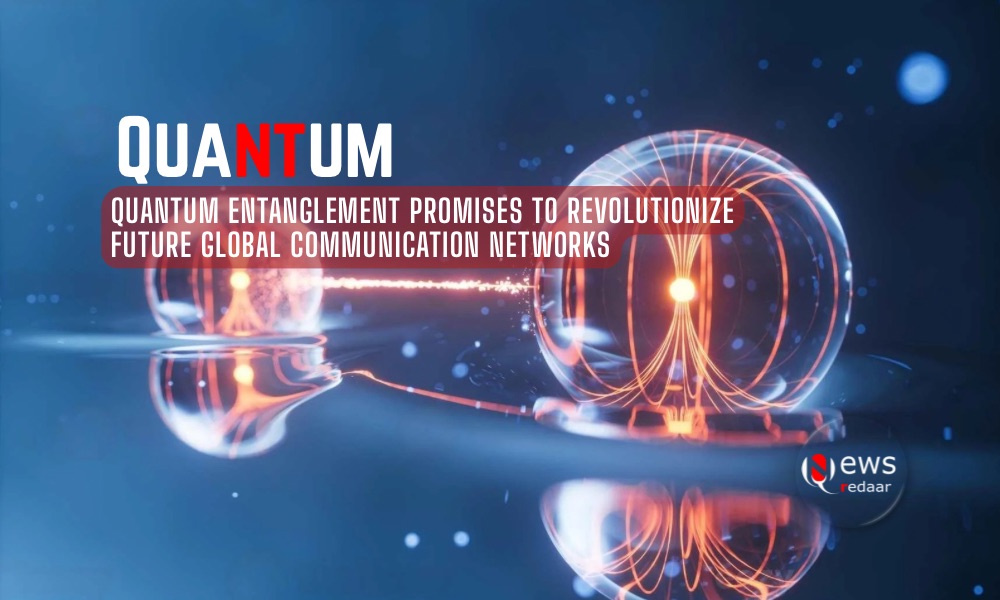
Quantum Entanglement Promises To Revolutionize Future Global Communication Networks
latest update, News
Scientists say that quantum entanglement, one of the most mysterious phenomena in physics, could soon revolutionize global communication networks. The discovery, which Einstein once called “spooky action at a distance,” may become the foundation for the next generation of ultra-secure and lightning-fast data transmission systems.
Quantum entanglement occurs when two or more particles
become linked in such a way that the state of one instantly affects the other,
no matter how far apart they are. This extraordinary property defies
traditional physics and opens new doors for creating communication systems that
are faster, safer, and virtually impossible to hack.
Recent breakthroughs in quantum research have pushed this
concept closer to reality. Teams of physicists in China, the United States, and
Europe have successfully demonstrated quantum communication over long distances
using entangled photons. These experiments prove that it is possible to
transmit information instantly across large networks without relying on
traditional data carriers like cables or satellites.
Experts believe that quantum entanglement-based
communication could transform how the world connects. Unlike conventional
internet signals, which can be intercepted or corrupted, quantum networks rely
on the principles of physics itself for protection. Any attempt to intercept a
quantum message immediately alters its state, alerting both sender and receiver
to a security breach.
This breakthrough could also lead to the creation of a “quantum
internet”, a next-generation network that connects quantum computers and
communication devices worldwide. Such a system could make data transfer nearly
instantaneous, improve encryption standards, and drastically reduce latency for
critical services like defense, finance, and scientific research.
However, building a global quantum network is not without
challenges. Scientists still face major technical hurdles, such as maintaining
entanglement over long distances and ensuring stability in varying
environments. Current experiments rely heavily on advanced optics, satellite
relays, and extremely low temperatures to preserve quantum states—conditions
that are not yet practical for everyday use.
Governments and private tech companies are investing heavily
to overcome these barriers. The United States, China, and the European Union
have launched multi-billion-dollar quantum research programs aimed at
developing secure communication infrastructures. Major corporations like IBM,
Google, and Alibaba are also exploring commercial applications of quantum
communication.
Experts predict that within the next decade, small-scale
quantum networks could begin operating between research institutions, defense
systems, and financial centers. Over time, these networks could expand into
public systems, enabling ordinary users to experience unprecedented levels of
communication speed and privacy.
As the world races to harness quantum technology, one thing
is clear: quantum entanglement could redefine how humanity shares
information. From preventing cyberattacks to connecting distant corners of the
world instantly, this scientific phenomenon might soon turn from a theory into
one of the most powerful tools of the digital age.